2. What is matter
I'm surrounded by all this... stuff!
Let’s kick off your radiation therapy physics concepts reviews!
These reviews are designed to help you strengthen your understanding, one concept at a time, so you can feel more confident in your studies and clinical practice. Let's go!
What is matter?
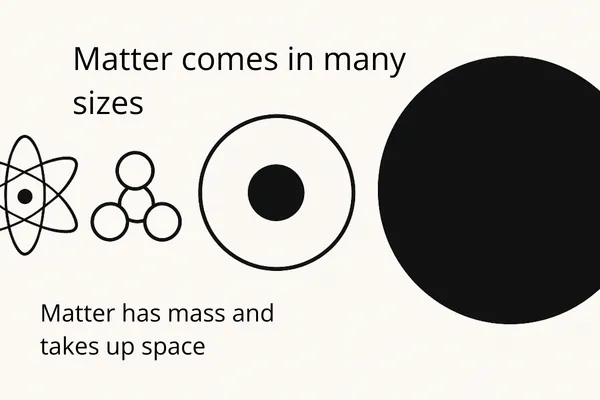
Matter is anything that has mass and occupies space. That means everything around us — mountains, buildings, cars, rocks, sand, and even powder — is made of matter. Matter is the "stuff" we can touch and feel. Mass is the amount (quantity) of "stuff" (matter). Whether it’s something huge like a mountain or tiny like a grain of sand, it all counts because it takes up space.
If we keep breaking things down smaller and smaller, we eventually reach the atom:
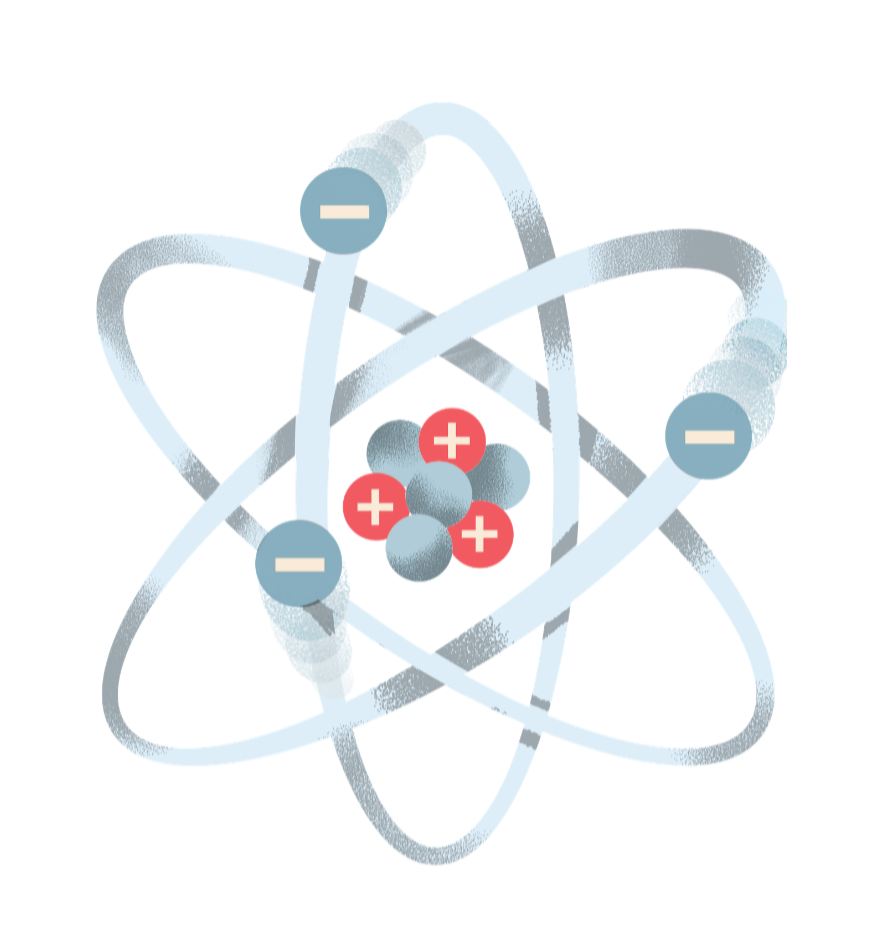
For a quick refresher: Atoms are made up of orbiting electrons (tiny particles) that are negatively charged, and a central nucleus. The nucleus is where the large particles hang out together. It contains protons (positively charged particles) and neutrons (neutral, or, no charge.) Electrons are tiny, and protons & neutrons are large (approximately 1800 times larger than electrons). The majority of the mass of an atom is found in its nucleus!
The atom is the smallest unit of matter that still behaves the way we expect. For example, gold atoms will still be yellow, and oxygen atoms are what make the air we breathe support life. But once we go smaller than the atom, into particles like protons, neutrons, and electrons, things start behaving very differently from the world we see around us. If you break apart a gold atom, it is no longer gold.
Going deeper:
All matter, no matter how big or small, is made up of these atoms. In radiation therapy, understanding how radiation interacts with atoms is essential, because that’s how we can target and treat tumors effectively.
Key ideas to remember:
Ionization: Radiation can knock electrons out of atoms, creating ions (remember: an ion is an atom that has lost an electron). This is how radiation damages cancer cells.
Density and composition: Different tissues in the body have different densities, which affects how radiation is absorbed or scattered.
We’ll build on this foundation in the next few emails, where we’ll explore the four fundamental forces of nature and how they relate to the physics behind radiation therapy.
You’re doing brilliantly — keep going!
Making physics less scary, one concept at a time,
Sara
