16. Radiation Introduction
Radiation Introduction: Particle vs. Electromagnetic
Two different types of radiation.
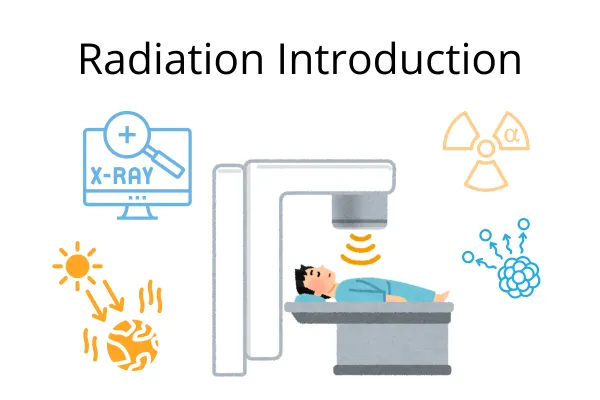
When we talk about radiation in medical physics, we’re really talking about two different types: particle radiation and electromagnetic radiation.
Particle radiation involves actual particles with mass and, often, charge. Examples include:
- Alpha particles — heavy and highly ionizing, but with low penetration.
- Beta particles — lighter, moderately penetrating, used in some therapy sources.
- Neutrons and protons — both show up in specialized or advanced therapies, with protons offering precise dose delivery thanks to the Bragg peak.
Electromagnetic radiation, on the other hand, has no mass or charge. It travels as waves of energy, and includes x-rays and gamma rays. These photons interact with matter through processes like the photoelectric effect, Compton scattering, and pair production — the very interactions we’ve been exploring in this series.
Understanding the difference between these two types of radiation helps you see why certain types are used for imaging, while others are chosen for treatment.
Warmly,
Sara
