26. Radiation from Atomic Nuclei
Radiation from Atomic Nuclei
Explore how energy, mass, and the nucleus are connected through binding energy and Einstein’s famous equation.
We already explored where x-rays come from and how photons interact with matter through the photoelectric effect, Compton scattering, and pair production. In each interaction, energy is transferred, absorbed, or used to create particles.
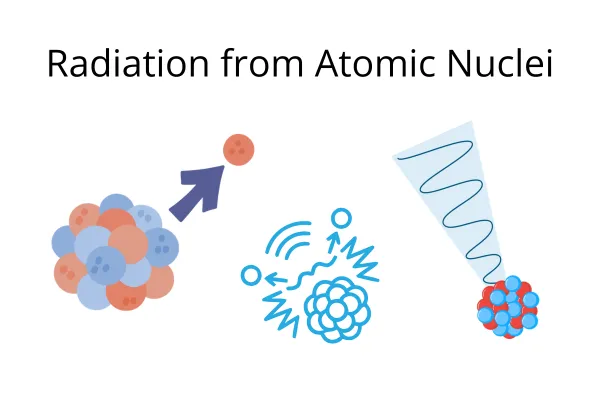
Next, we need to look at nuclear sources of radiation, and explore where it comes from.
Inside the nucleus of the atom, we have protons and neutrons, in a delicate configuration. But, looking more closely, there is something very mysterious happening!
You might assume that if you add together the masses of all the protons, neutrons, and electrons in an atom, you would get the atom’s total mass. But that is not quite what happens.
The mass of a bound atom, especially its nucleus, is slightly less than the combined masses of its separate particles. This difference is called the mass defect. 🤔
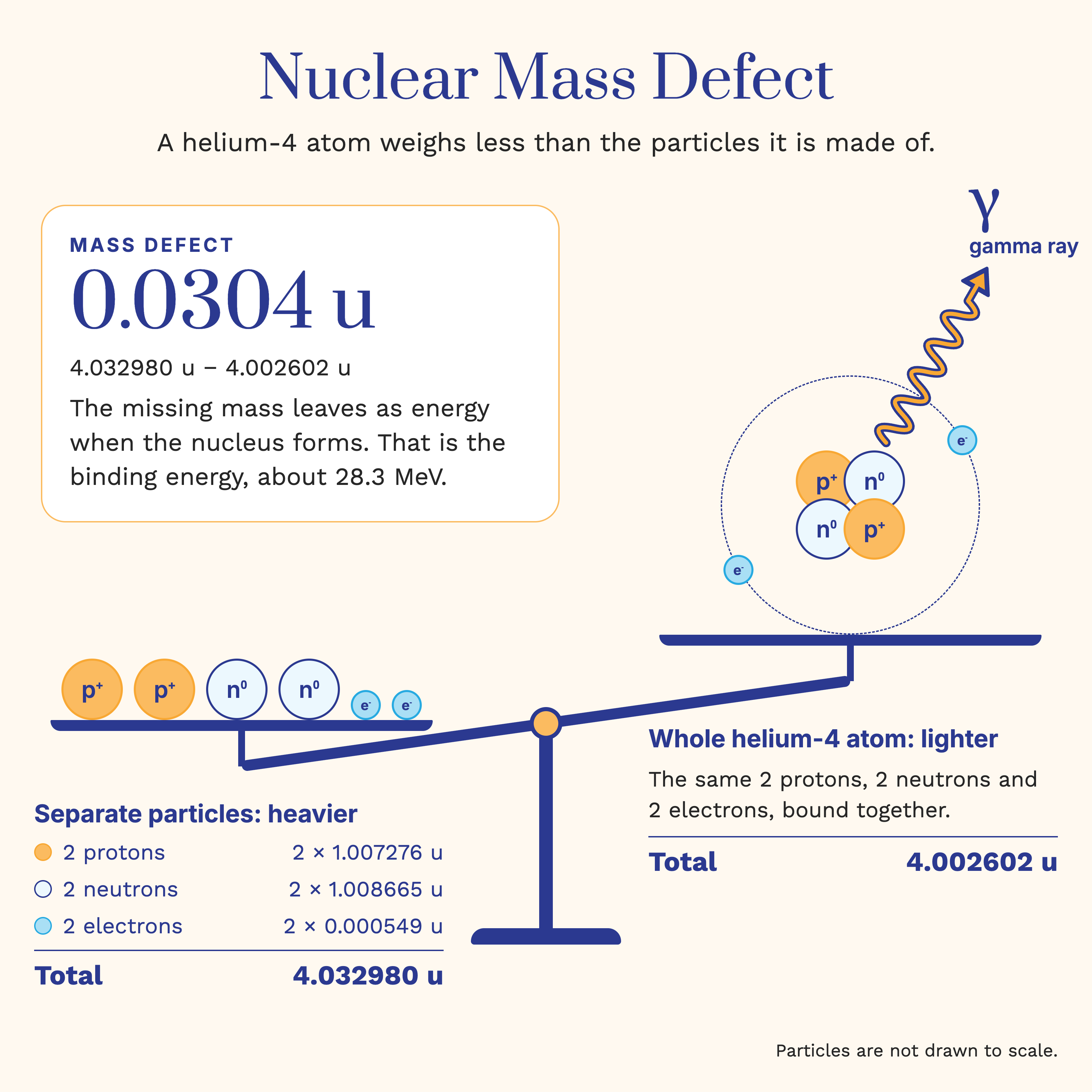
So, where did that missing mass go?
When protons and neutrons join together to form a nucleus, energy is released. That energy is associated with the force holding the particles together, called the strong nuclear force (we are coming around full circle, now!) The energy needed to separate a nucleus completely into its individual protons and neutrons is called its binding energy. 🤯
Einstein’s famous equation explains the link between mass and energy:
E = mc²
This tells us that mass and energy are interchangeable. Even a tiny amount of mass can become a very large amount of energy because it is multiplied by the speed of light squared.
The mass defect represents the mass that was converted into binding energy when the nucleus formed. A nucleus with a high binding energy is generally more tightly bound and more stable.
This same principle explains how energy can be released in nuclear reactions. In fission, heavy nuclei split apart. In fusion, light nuclei join together. If the products are more tightly bound and have a lower total mass, the difference in mass is converted into energy, often as kinetic energy, heat, or radiation.
This is one of the most important ideas in nuclear physics: the nucleus has less mass because some of that mass became the energy that holds it together.
In the next email, we will look at nuclear stability and explore why some nuclei are stable while others undergo radioactive decay.
Forever a fan of cool physics equations,
Sara
