19. Photoelectric & Coherent
Photoelectric Effect & Coherent (Rayleigh) Scattering
Understanding which interactions are important for treatment energies.
Now that you know about transmission and attenuation, let’s look at two types of interactions that occur when photons meet matter — photoelectric effect and coherent scattering.
Both of these interactions are most significant at low photon energies, such as those used in diagnostic imaging (like X-rays).
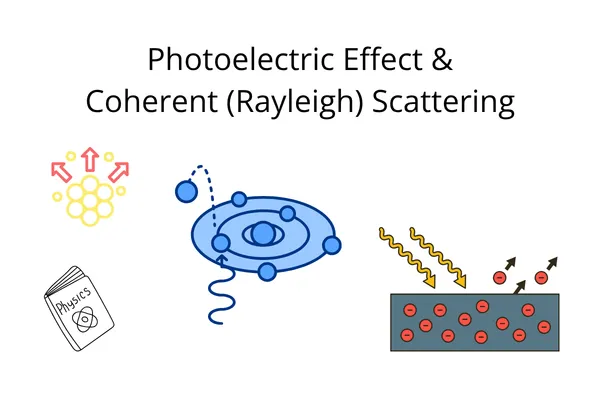
- In the photoelectric effect, the photon (a particle of light or radiation) transfers all its energy to one of the atom’s inner-shell electrons, ejecting it from the atom. This leaves behind a vacancy that can cause characteristic x-rays or Auger electrons to be emitted as the atom returns to equilibrium (other electrons fall to lower shells to fill the vacancies). The photoelectric effect is most likely to occur at low energies (like in diagnostic X-rays) and in materials with a high atomic number, (like bone or lead).While the photoelectric effect doesn’t contribute much to dose in radiation therapy, it plays a major role in diagnostic imaging
- Coherent (or Rayleigh) scattering happens when a photon interacts with the whole atom rather than with individual electrons. The photon’s energy is too low to knock an electron out of its shell, so no energy is lost. Instead, the photon simply changes direction slightly, almost like a light wave bouncing off a smooth surface. Because there’s no energy transfer, coherent scattering doesn’t have a significant effect on dose in radiation therapy.
In radiation therapy, we use much higher photon energies (megavoltage range). At these energies, both photoelectric and coherent scattering contribute very little to the overall dose. Instead, Compton scattering becomes the dominant interaction — and that’s what we’ll explore next.
Understanding which interactions matter most helps you see why treatment beams behave the way they do in tissue.
Keep the energy high,
Sara
