21. Pair Production
Pair Production - When Energy Becomes Matter
What happens when photons have enough energy to create particles.
Now that we’ve covered Compton scattering, let’s look at another fascinating interaction, pair production.
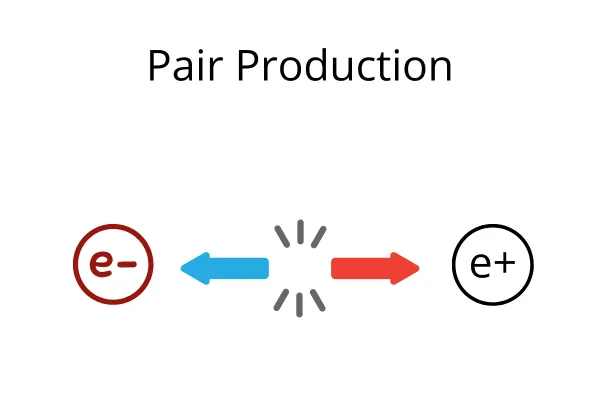
Pair production occurs only at very high photon energies, above 1.02 MeV. At this energy, a photon has enough energy to transform into matter. When the photon passes close to the nucleus of an atom, it disappears and its energy is converted into two new particles, an electron and a positron (which is the electron’s antimatter twin).
The energy of the photon must be at least equal to the combined rest mass energy of these two particles (0.511 MeV each). Any extra energy the photon has beyond that threshold is shared as kinetic energy, giving the electron and positron some speed as they move away from the nucleus.
After traveling a short distance, the positron eventually collides with an electron, and the two annihilate each other, releasing two photons with energies of 0.511 MeV each.
Pair production becomes significant at photon energies above about 10 MeV, and in high atomic number (Z) materials, such as the components inside the linear accelerator. It’s an important concept for understanding what happens at those very high energies.
Making the invisible visible,
Sara
P.S. You might remember from our last email that Compton scattering is the dominant interaction in the megavoltage range used for treatment. Pair production takes over only when photon energies climb even higher, above about 10 MeV. So together, these two interactions help explain how photons behave across the full energy range we use in radiation therapy.
