17. Ionization & Excitation
Ionization & Excitation
How Excitation and Ionization Shape Radiation Interactions
Today’s mini lesson dives into how radiation interacts with atoms — specifically through excitation and ionization.
Excitation happens when a charged particle, like an electron, passes close to an atom and transfers just enough energy to raise one of the atom’s electrons to a higher energy level, but not enough to remove it completely. The atom becomes “excited” but stays neutral overall.
After a very short time, that excited electron drops back to its original energy level, releasing the extra energy as heat or light. In radiation therapy, this process helps explain how radiation gradually loses energy as it travels through tissue, although it doesn’t directly cause ionization.
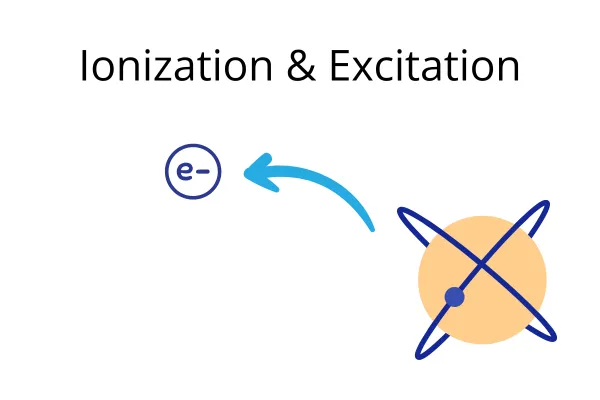
Ionization, on the other hand, occurs when enough energy is transferred to completely remove an electron from the atom, creating an ion pair — a positive ion and a free electron. This is the main process responsible for biological damage, since it can break chemical bonds in DNA.
You’ll also hear about other related interactions:
- Elastic scattering: The incoming particle changes direction but not energy.
- Inelastic scattering: The particle loses energy through excitation or ionization.
- Bremsstrahlung (braking radiation): High-speed electrons deflected by the nucleus emit x-rays.
In short, excitation shakes the atom, while ionization breaks it apart. Both are essential to understanding how radiation deposits dose in tissue.
Study tip: When reviewing this topic, try sketching the difference between excitation and ionization — visualizing it helps it stick!
See you next week for another mini lesson.
Warmly,
Sara
